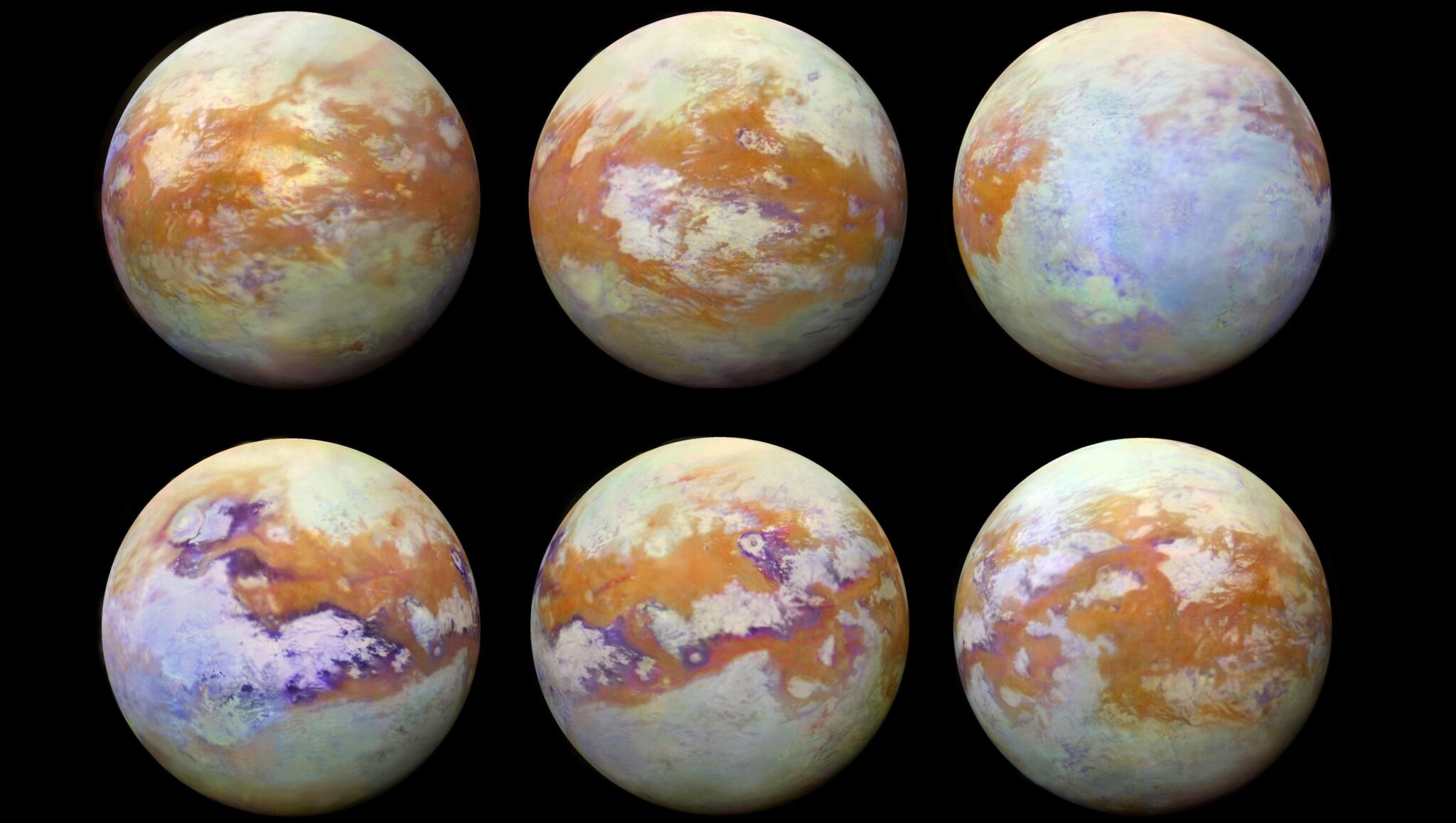
Methane clouds on Titan, Saturn’s largest moon, are more than just a celestial oddity — they’re a window into one of the solar system’s most complex climates. Until now, mapping them has been slow and grueling work. Enter AI: a team from NASA, UC Berkeley and France’s Observatoire des Sciences de l’Univers just changed the game. Using NVIDIA GPUs, the researchers trained a deep learning model to analyze years of Cassini data in seconds. Their approach could reshape planetary science, turning what took days into moments. “We were able to use AI to greatly speed up the work of scientists, increasing productivity and enabling questions to be answered that would otherwise be impractical,” said Zach Yahn, Georgia Tech PhD student and lead author of the study. Read the full paper, “Rapid Automated Mapping of Clouds on Titan With Instance Segmentation.” How It Works At the project’s core is Mask R-CNN — a deep learning model that doesn’t just detect objects. It outlines them pixel by pixel. Trained on hand-labeled images of Titan, it mapped the moon’s elusive clouds: patchy, streaky and barely visible through a smoggy atmosphere. The team used transfer learning, starting with a model trained on COCO (a dataset of everyday images), and fine-tuned it for Titan’s unique challenges. This saved time and demonstrated how “planetary scientists, who may not always have access to the vast computing resources necessary to train large models from scratch, can still use technologies like transfer learning to apply AI to their data and projects,” Yahn explained. The model’s potential goes far beyond Titan. “Many other Solar System worlds have cloud formations of interest to planetary science researchers, including Mars and Venus. Similar technology might also be applied to volcanic flows on Io, plumes on Enceladus, linea on Europa and craters on solid planets and moons,” he added. Fast Science, Powered by NVIDIA NVIDIA GPUs made this speed possible, processing high-resolution images and generating cloud masks with minimal latency — work that traditional hardware would struggle to handle. NVIDIA GPUs have become a mainstay for space scientists. They’ve helped analyze Webb Telescope data, model Mars landings and scan for extraterrestrial signals. Now, they’re helping researchers decode Titan. What’s Next This AI leap is just the start. Missions like NASA’s Europa Clipper and Dragonfly will flood researchers with data. AI can help handle it, processing it onboard, mid-mission, and even prioritizing findings in real time. Challenges remain, like creating hardware fit for space’s harsh conditions, but the potential is undeniable. Methane clouds on Titan hold mysteries. Researchers are now unraveling them faster than ever with help from new AI tools accelerated by NVIDIA GPUs. Read the full paper, “Rapid Automated Mapping of Clouds on Titan With Instance Segmentation.” Image Credit: NASA Jet Propulsion Laboratory
Categories: Accelerated AnalyticsAI InfrastructureCorporateDeep Learning
Related News
AI Infrastructure
NVIDIA Unlocks AI Compute at Scale, Inviting Capital Partners to Power the AI Infrastructure Buildout
Jul 1, 2026
AI Infrastructure
Claude Meets Blackwell Ultra: Anthropic’s Models Now Run on NVIDIA GB300 in Azure
Jun 29, 2026
AI Infrastructure
NVIDIA and AWS Collaborate to Bring AI to Production at Scale
Jun 23, 2026
AI
How Businesses Are Building Specialized AI They Can Trust
Jun 23, 2026


